Can We Trust the Bible?
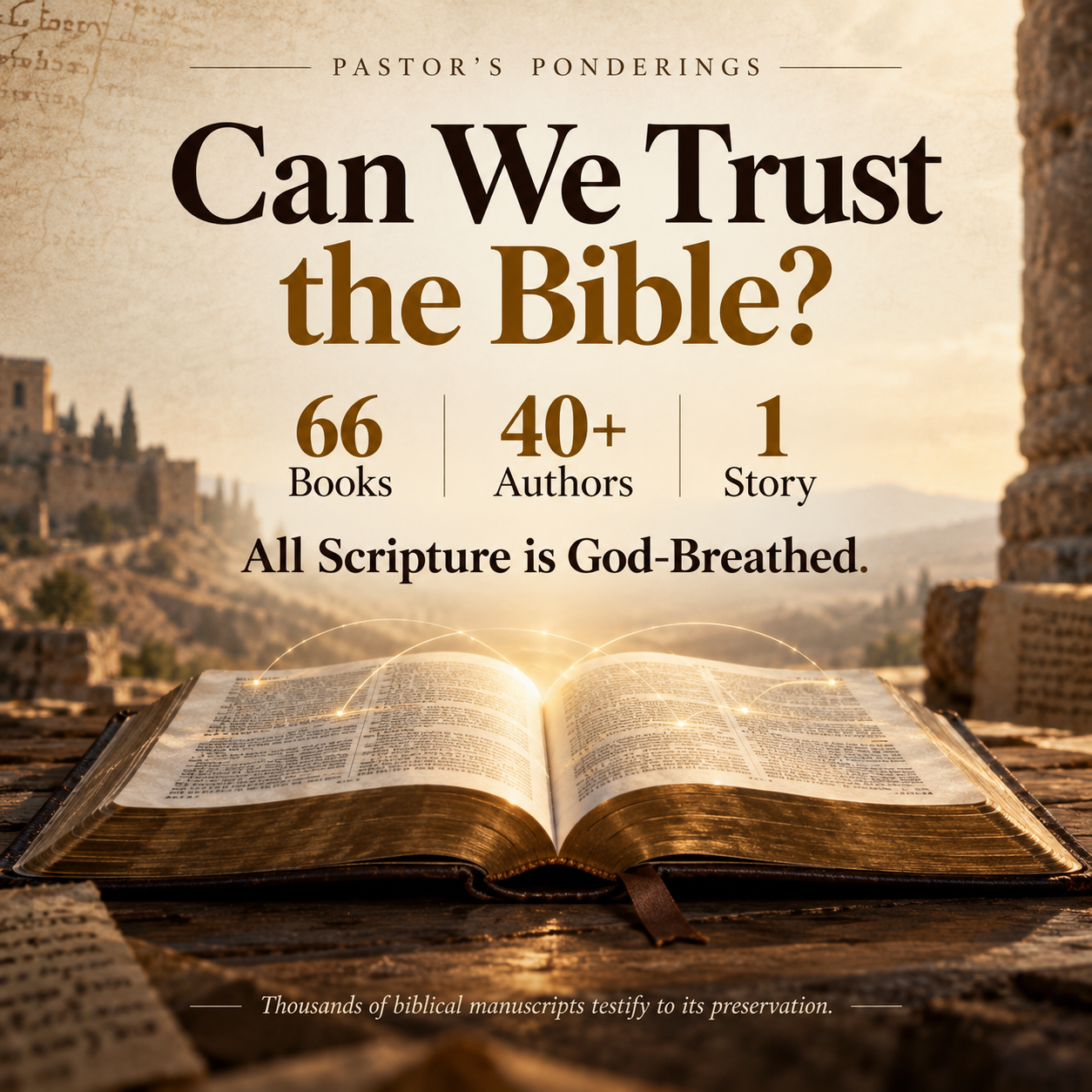
The remarkable history, unity, and divine inspiration of Scripture
What if I told you that there was a book written over the course of more than a thousand years, by dozens of different authors, from different countries, cultures, occupations, and backgrounds, and yet, when their writings were brought together, they told one unified story?
What if I told you that this book contained thousands of connections between its various writings? That people, places, events, promises, and prophecies introduced in its earliest chapters would find their fulfillment hundreds, sometimes more than a thousand, years later? That themes introduced by one author would be developed by another, and that the entire collection would ultimately point us toward one central figure?
If a single human being had accomplished such a feat, we would undoubtedly recognize that person as one of the greatest literary minds in human history.
But the Bible was not written by a single human author. Its books were written by many different men, living in different generations, separated by vast distances and vastly different circumstances. Some were kings, others were shepherds, fishermen, prophets, priests, and apostles. Some wrote from palaces, others from prison cells. Some wrote poetry, others history, prophecy, wisdom literature, letters, and eyewitness accounts.
And yet, through all of these different voices, we hear one consistent message: God created us, humanity fell into sin, and God, in His extraordinary love and faithfulness, has been working throughout history to redeem His people through His Son, Jesus Christ.
How is that possible?
The answer is that, although Scripture has many human authors, it has only one ultimate Author.
As Paul writes in 2 Timothy 3:16–17 (ESV), "All Scripture is breathed out by God and profitable for teaching, for reproof, for correction, and for training in righteousness, that the man of God may be complete, equipped for every good work."
Peter likewise reminds us that "men spoke from God as they were carried along by the Holy Spirit" (2 Peter 1:21).
This is what we mean when we confess that the Bible is the inspired Word of God. God did not simply hand us an interesting collection of religious writings. He worked through real human beings, their personalities, experiences, vocabularies, and historical circumstances, to give us His Word.
But can we trust that the Bible we have today is actually the Bible that was written so long ago? And how do we know that the books in our Bibles are the ones that belong there?
Those are wonderful questions, and the history behind their answers is remarkable.
Has the Bible been changed over time?
One of the most common arguments against the reliability of Scripture is that it has been copied and translated so many times that we cannot possibly know what the original authors wrote.
I understand why someone might think that. After all, we are talking about documents written thousands of years ago, long before the invention of the printing press. The original handwritten documents, sometimes called the autographs, have not survived. So how can we be confident that the words we read today accurately reflect what was written?
The answer lies in the extraordinary number of ancient manuscripts that have survived.
The Institute for New Testament Textual Research in Münster, Germany, reported approximately 5,700 catalogued Greek New Testament manuscript witnesses in 2023. These include everything from small fragments containing a few verses to large collections containing entire biblical books. Not every manuscript contains the whole New Testament, and some of the catalogued witnesses are no longer physically available, but the sheer volume of surviving evidence is remarkable.
Now compare that with some of the most celebrated works of classical literature.
Consider the works of Homer, the ancient Greek poet credited with writing the Iliad and the Odyssey. Approximately 1,500 ancient papyrus fragments containing portions of the Iliad survive, along with roughly 300 medieval manuscripts containing the Iliad or the Odyssey. These are among the most extensively preserved works of ancient Greek literature.
Or consider Tacitus, the famous Roman historian whose Annals document the history of the Roman Empire. The surviving text depends primarily upon just two medieval manuscripts, with later copies deriving from them. Portions of his original work have been lost entirely.
Even William Shakespeare, who lived more than 1,500 years after the apostles, presents an interesting comparison. We possess no surviving original handwritten manuscripts of his plays. His famous First Folio, published in 1623, originally had an estimated print run of 750 copies. Only 235 are known to survive today.
Now compare these figures with the New Testament. The Institute for New Testament Textual Research reported approximately 5,700 catalogued Greek New Testament manuscript witnesses in 2023. These include small fragments, substantial portions of individual books, and manuscripts containing entire collections of biblical writings. And this number does not include the extensive manuscript traditions of the New Testament in Latin, Syriac, Coptic, and other ancient languages.
The point is not that every New Testament manuscript is complete or that the number of surviving copies proves divine inspiration. Rather, the extraordinary abundance of manuscript evidence allows scholars to compare witnesses from different centuries and geographical locations, identify copying variations, and carefully investigate the wording of the earliest recoverable biblical text.
We have far more than a single ancient copy of the New Testament. We have thousands of witnesses through which we can examine how the Word of God has been transmitted across the centuries.
And this abundance of manuscripts is important for another reason.
Imagine that I wrote you a letter and asked a hundred people to make handwritten copies of it. Over time, some copyists might accidentally skip a word, repeat a sentence, misspell something, or write a slightly different phrase. But because we have so many copies, we can compare them to identify where mistakes may have occurred.
That is precisely what biblical textual scholars do. By comparing ancient manuscripts from different locations and periods, they can identify differences and examine the evidence for the earliest recoverable wording of Scripture.
There are, in fact, textual variations among biblical manuscripts. We should not pretend otherwise. Most are relatively small, while a few involve longer passages, such as the ending of Mark's Gospel or the account of the woman caught in adultery in John 7–8. These differences deserve careful examination, and good Bible translations often include footnotes identifying them.
But that is the beauty of having such an extraordinary collection of manuscripts. We are not dependent upon a single surviving document or a long chain of copies that cannot be checked against one another. We have thousands of witnesses available for comparison.
And the evidence is not limited to the New Testament.
In 1947, the first of the Dead Sea Scrolls were discovered in caves near the Dead Sea. Among the discoveries were approximately 230 biblical manuscripts, containing portions of every book of the Hebrew Bible except Esther.
Some of these manuscripts were more than a thousand years older than the medieval Hebrew manuscripts that scholars had previously relied upon. When compared with the later biblical texts, many revealed remarkable continuity across those centuries, even while preserving some differences in spelling and wording, as well as other textual variations.
Think about that for a moment. We have physical manuscript evidence of biblical writings from before the birth of Jesus Christ, and we can compare those writings with the Scriptures that have been passed down to us today.
Our confidence in the preservation of Scripture is not based simply on assuming that every copyist throughout history did everything perfectly. It rests upon the ability to examine the evidence and see how these writings have been transmitted across the centuries.
The preservation of God's Word is not a story of perfect human scribes. It is a story of God's Word enduring through the work of imperfect human beings.
Who decided which books belong in the Bible?
This brings us to another question that I frequently hear: Who decided which books belong in the Bible? Why do we have Matthew, Mark, Luke, and John, but not the Gospel of Thomas or the Gospel of Judas? Did someone simply choose the books they liked and discard the rest?
The answer is that the formation of the biblical canon was a careful historical process. And understanding that process helps us appreciate the integrity of Scripture even more.
The word canon refers to a standard or rule. When we speak of the biblical canon, we are referring to the collection of writings recognized as Holy Scripture.
The Old Testament was already the sacred Scripture of the Jewish people when Jesus walked the earth. Jesus Himself frequently appealed to its authority, quoted its writings, and taught that they testified about Him (Luke 24:27, 44–47).
The apostles likewise preached from these Scriptures, showing how God's promises were fulfilled in the life, death, and resurrection of Jesus Christ.
As the Christian Church grew, the apostles and their close companions wrote letters, Gospels, and other writings to instruct the Church in the faith. These writings were copied, circulated among congregations, and read publicly during worship.
But not every religious writing that appeared during this period was recognized as Scripture. As the Church spread, Christian leaders had to distinguish the authentic apostolic writings from other works that claimed religious authority.
The early Church considered several important questions when recognizing the books of the New Testament.
1. Apostolic authority
Was this book written by an apostle or someone closely associated with the apostles?
Matthew and John were apostles. Mark was closely associated with Peter, and Luke was a companion of Paul. The Church sought writings connected to those whom Jesus had commissioned to proclaim His Gospel.
2. Faithfulness to apostolic teaching
Did the writing agree with the faith that Christ had entrusted to His apostles?
A book that introduced a fundamentally different understanding of God, Jesus, creation, or salvation could not simply claim the authority of Scripture. The Church compared such writings with the apostolic teaching that had already been received.
3. Widespread recognition
Was the writing recognized as authoritative by Christian congregations throughout the Church?
A book known only to a particular religious group, especially one appearing long after the apostolic age, did not carry the same historical credentials as writings that had been received and circulated among the early churches.
4. Use in Christian worship
Was the writing being read publicly as Scripture when Christians gathered for worship?
From the beginning, Christians gathered around God's Word. The writings regularly received and read as Scripture across the churches helped demonstrate which books the Christian community recognized as authoritative.
These were not four tests invented at a single meeting. They describe important considerations that helped the early Church distinguish apostolic Scripture from other religious literature.
Now, there is an important distinction here. The Church did not make these writings inspired by placing them in the Bible. Rather, Christians understand the Church's responsibility as recognizing the writings God had already inspired.
In other words, the authority of Scripture comes from God, not from a committee of human beings.
This recognition developed over time. There was widespread agreement about the four Gospels and many apostolic letters relatively early, while certain books, including Hebrews, James, and Revelation, received additional scrutiny in portions of the Church. In AD 367, Athanasius of Alexandria provided the earliest surviving list containing precisely the same 27 New Testament books that we recognize today.
This process was not without historical discussion or disagreement, but it was also not a matter of a Roman emperor suddenly deciding what Christians would be allowed to believe.
The Church carefully examined the writings it had received, and the books of the New Testament came to be recognized as the authoritative apostolic witness to Jesus Christ.
What about the books that were left out?
People sometimes ask whether the Church intentionally removed certain books from the Bible because they contained teachings that church leaders wanted to hide.
Consider the so-called Gospel of Thomas or Gospel of Judas.
Although these writings bear the names of biblical figures, their surviving texts come from a later period than the New Testament writings. They cannot be established as works written by the apostles whose names they bear. Some also reflect theological perspectives substantially different from the apostolic teaching preserved in the New Testament.
Consequently, these books were not received as authoritative apostolic Scripture.
That is different from saying that the apostles personally examined and rejected every later writing. Many such books appeared after the apostles had died.
It is also important to distinguish these writings from other early Christian works, such as the Shepherd of Hermas or the letters of Clement. Some of these were highly regarded by early Christians and remain valuable historical and theological resources, even though they were not ultimately recognized as part of the New Testament canon.
And what about the Old Testament Apocrypha?
These ancient Jewish writings were included in many historical Christian Bibles, including Luther's German Bible. Luther regarded them as useful reading but distinguished them from the canonical Scriptures. Catholic and Orthodox Christian traditions recognize different Old Testament canons, so the disagreement over these books is a distinct historical and theological question from the rejection of later writings that falsely claimed apostolic authority.
For us as Confessional Lutherans, the Bible contains 66 canonical books: 39 in the Old Testament and 27 in the New Testament.
We do not need to fear the existence of other ancient writings. Studying them can help us better understand the historical world in which Christianity developed. But we must distinguish between writings that offer historical insight and those that God has given His Church as the authoritative foundation for faith and life.
The careful recognition of the canon helps safeguard that distinction.
One remarkable story, one divine Author
Now, let's return to where we began.
We have a collection of writings composed across many centuries, by numerous human authors, in different languages, cultures, and circumstances. Their writings have been preserved through an extraordinary manuscript tradition, and the Church has carefully distinguished the writings it recognizes as inspired Scripture from other religious works.
And when we open this collection of books, what do we find?
We discover thousands of connections that weave these individual writings together into one extraordinary story.
In Genesis 3:15, following humanity's fall into sin, God promises that the offspring of the woman will crush the serpent's head. From that moment forward, Scripture unfolds the story of God's promised deliverance.
When Abraham is called, God promises that through his offspring all the families of the earth will be blessed (Genesis 12:3). When Israel celebrates the Passover, the blood of the lamb protects God's people from judgment (Exodus 12). Centuries later, Isaiah describes the suffering Servant who bears the sins of many (Isaiah 53).
And then we arrive at the New Testament.
John the Baptist sees Jesus approaching and declares, "Behold, the Lamb of God, who takes away the sin of the world!" (John 1:29, ESV).
Paul identifies Christ as our Passover Lamb (1 Corinthians 5:7), while Peter connects the suffering of Jesus with Isaiah's description of the Servant who bore our sins (1 Peter 2:24–25).
What began in Genesis finds its fulfillment in Jesus Christ, and what Christ accomplished on the cross reaches its glorious conclusion in Revelation, where God's redeemed people dwell with Him forever.
These connections are not limited to a few conveniently selected passages. The themes of creation, sin, sacrifice, covenant, mercy, redemption, and restoration run throughout the Scriptures, joining together the many books of the Bible.
Now, I recognize that some people will point to passages in Scripture that seem to contradict one another. Different accounts sometimes emphasize different details, and there are difficult passages that require careful examination. We should never be afraid to study those questions or pretend that every interpretive challenge has a simple answer.
But as Christians who confess Scripture to be God's inspired and inerrant Word, we believe that its teachings do not ultimately contradict one another. The unity of Scripture does not require every human author to write in the same style, recount the same details, or emphasize the same aspect of God's work. Instead, through the distinctive voices of its authors, we hear the consistent testimony of God's saving work in Jesus Christ.
The historical evidence for the Bible's preservation and the remarkable unity of its message are wonderful reasons to take Scripture seriously. Yet these observations alone cannot scientifically prove that God inspired every word. That is ultimately a confession of faith, grounded in Scripture's own testimony and in the work of the Holy Spirit.
And what does Scripture testify?
That we have a God who loves His creation, who pursues His fallen people, who keeps His promises, and who has accomplished our salvation through the death and resurrection of His Son.
Jesus Himself tells us the purpose of the Scriptures in John 5:39: "It is they that bear witness about me" (ESV).
And John explains why he wrote his Gospel:
"These are written so that you may believe that Jesus is the Christ, the Son of God, and that by believing you may have life in his name" (John 20:31, ESV).
That is why the integrity of Scripture matters so much.
We are not merely studying an ancient book or appreciating an extraordinary literary achievement. We are receiving the very Word through which God reveals Himself, confronts us with our sin, declares His forgiveness, and gives us the promise of everlasting life through Jesus Christ.
The Bible is a collection of writings unlike any other. Many human authors, writing across many generations, telling one extraordinary story of redemption.
And behind every page stands the same faithful God, speaking His Word so that you might know Him, trust Him, and receive the life that He has prepared for you.