Pastor’s Ponderings - Not Spared From the Fire, But In It
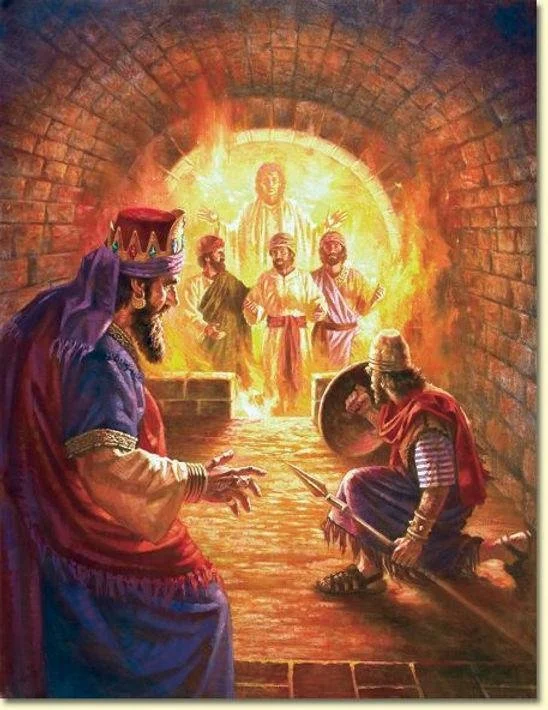
This weekend, many of us will gather to enjoy a musical retelling of the story of Shadrach, Meshach, and Abednego. It’s a creative and engaging way to bring this powerful account to life. There will be humor. There will be music. There will be moments that make us smile as a familiar story unfolds in a fresh way.
But beneath the laughter and the songs is one of the most profound truths in all of Scripture.
Because when we slow down and really look at what happens in Book of Daniel 3, we find something that cuts against how we often expect God to work.
God does not stop the fire.
That’s the part we don’t always anticipate. If we were writing the story, we might have God intervene earlier. Maybe the king has a change of heart. Maybe the decree never gets enforced. Maybe the furnace never even becomes part of the story. That’s how we tend to imagine divine rescue—preventative, immediate, and visible.
But that is not what God does here.
Shadrach, Meshach, and Abednego are bound. They are carried to the furnace. The fire is heated seven times hotter than usual. The soldiers who throw them in are killed by the intensity of the flames. And then—only then—do we see God act in a visible way.
He does not keep them from the fire.
He meets them in it.
That distinction matters more than we might realize.
The Expectation We Carry
We often live with an unspoken assumption about God: if we are faithful, He will keep us from harm. If we trust Him, He will remove the obstacles. If we stand firm, He will reward us with comfort, safety, and ease.
It’s not that we would say this out loud, but it quietly shapes how we pray and how we interpret our circumstances. When something difficult arises, we instinctively ask, “Why didn’t God stop this?”
Why didn’t He prevent the diagnosis?
Why didn’t He protect the relationship?
Why didn’t He remove the hardship before it ever reached me?
The story of the fiery furnace gently—but firmly—corrects that expectation.
God’s promise has never been that we will avoid the fire. His promise is that we will not face it alone.
“When You Walk Through Fire…”
Long before this moment in Babylon, God had already spoken a promise to His people:
“When you pass through the waters, I will be with you;
and through the rivers, they shall not overwhelm you;
when you walk through fire you shall not be burned,
and the flame shall not consume you.” (Isaiah 43:2, ESV)
Notice the language carefully.
Not if you walk through fire.
But when.
God does not say His people will be exempt from hardship. He says they will be accompanied through it.
This is exactly what we see fulfilled in Daniel 3. The fire is real. The danger is real. The suffering is real. And yet, so is the presence of God.
The Courage Before the Fire
What makes this account even more remarkable is that Shadrach, Meshach, and Abednego trust God before they ever see the miracle.
Their words to King Nebuchadnezzar are among the boldest statements of faith in all of Scripture:
“Our God whom we serve is able to deliver us from the burning fiery furnace… But if not… we will not serve your gods or worship the golden image that you have set up.” (Daniel 3:17–18, ESV)
There is no bargaining here. No conditions. No demands.
They do not say, “God will save us, so we can be faithful.”
They say, “We will be faithful, because God is God—whether He saves us or not.”
That is a different kind of faith. A deeper kind. A furnace-ready faith.
It is a faith that trusts not just in what God can do, but in who God is.
The Presence That Changes Everything
When Nebuchadnezzar looks into the furnace, he expects to see destruction. Instead, he sees something impossible:
“I see four men unbound, walking in the midst of the fire, and they are not hurt…” (Daniel 3:25, ESV)
The fire is still burning. The furnace is still blazing. But something has changed.
They are no longer bound.
They are no longer falling.
They are walking.
And they are not alone.
The presence of the fourth man does not remove the fire, but it transforms the experience of it.
What was meant for destruction becomes the setting for divine fellowship.
God’s Pattern Throughout Scripture
This is not an isolated moment. It reveals a pattern we see again and again throughout the Bible.
God does not always remove the trial.
He enters into it.
Joseph is not spared from betrayal or prison, but God is with him in Egypt.
David is not spared from the valley, but he fears no evil because God is with him (Psalm 23:4).
The disciples are not spared from the storm, but Jesus is in the boat (Mark 4:35–41).
And ultimately, we see this pattern most clearly in the life of Jesus Christ.
Jesus does not come to eliminate suffering from a distance. He steps into it.
He takes on flesh. He walks among us. He experiences hunger, exhaustion, grief, rejection. And finally, He enters into the deepest fire of all, the suffering and death of the cross.
God does not shout comfort from afar.
He draws near.
The Fire Still Feels Like Fire
It is important to say this clearly: the presence of God does not mean the fire stops feeling like fire.
Trials still hurt.
Loss is still painful.
Fear is still real.
The story does not deny the intensity of the furnace. In fact, it emphasizes it. The flames are so strong they kill the soldiers nearby.
And yet, in the midst of that very real danger, God is present in a way that sustains, protects, and ultimately delivers.
This is an important pastoral truth.
Faith does not mean pretending everything is fine.
It means trusting that God is at work, even when everything is not fine.
The Subtle Miracle
When the three men come out of the furnace, we are told something remarkable:
“The fire had not had any power over the bodies of those men. The hair of their heads was not singed, their cloaks were not harmed, and no smell of fire had come upon them.” (Daniel 3:27, ESV)
No smell of fire.
Think about that. Even after standing in the middle of the flames, there is no lingering trace.
This is more than survival. It is complete preservation.
It points forward to a greater promise—that the trials of this life, as real and painful as they are, will not have the final word over God’s people.
In Christ, even the fires we endure do not define us forever.
What This Means for Us
So what does this mean for us today?
It means that when we face the fires of life—whether they come in the form of illness, uncertainty, broken relationships, anxiety, or grief—we should not assume that God has abandoned us.
In fact, the opposite may be true.
The fire may be the very place where His presence becomes most clear.
It means that our prayers can shift—not just “Lord, take this away,” but also “Lord, be with me in this.”
It means that faith is not measured by how quickly our problems disappear, but by how deeply we trust God’s presence within them.
And it means that we can walk into even the hardest moments with confidence—not because we are strong, but because we are not alone.
Back to the Furnace
As you watch the musical this weekend, enjoy the humor. Laugh at the characters. Take in the story as it unfolds.
But don’t miss the deeper truth playing out on stage.
When the fire is lit and the tension rises, remember:
God does not always stop the flames.
But He steps into them.
Shadrach, Meshach, and Abednego were not spared from the fire—but they were never alone in it.
And neither are you.
Because the same God who walked in the furnace…
is the God who walks with you still.