Pastor’s Ponderings - Do You Wear Clothes in Heaven?
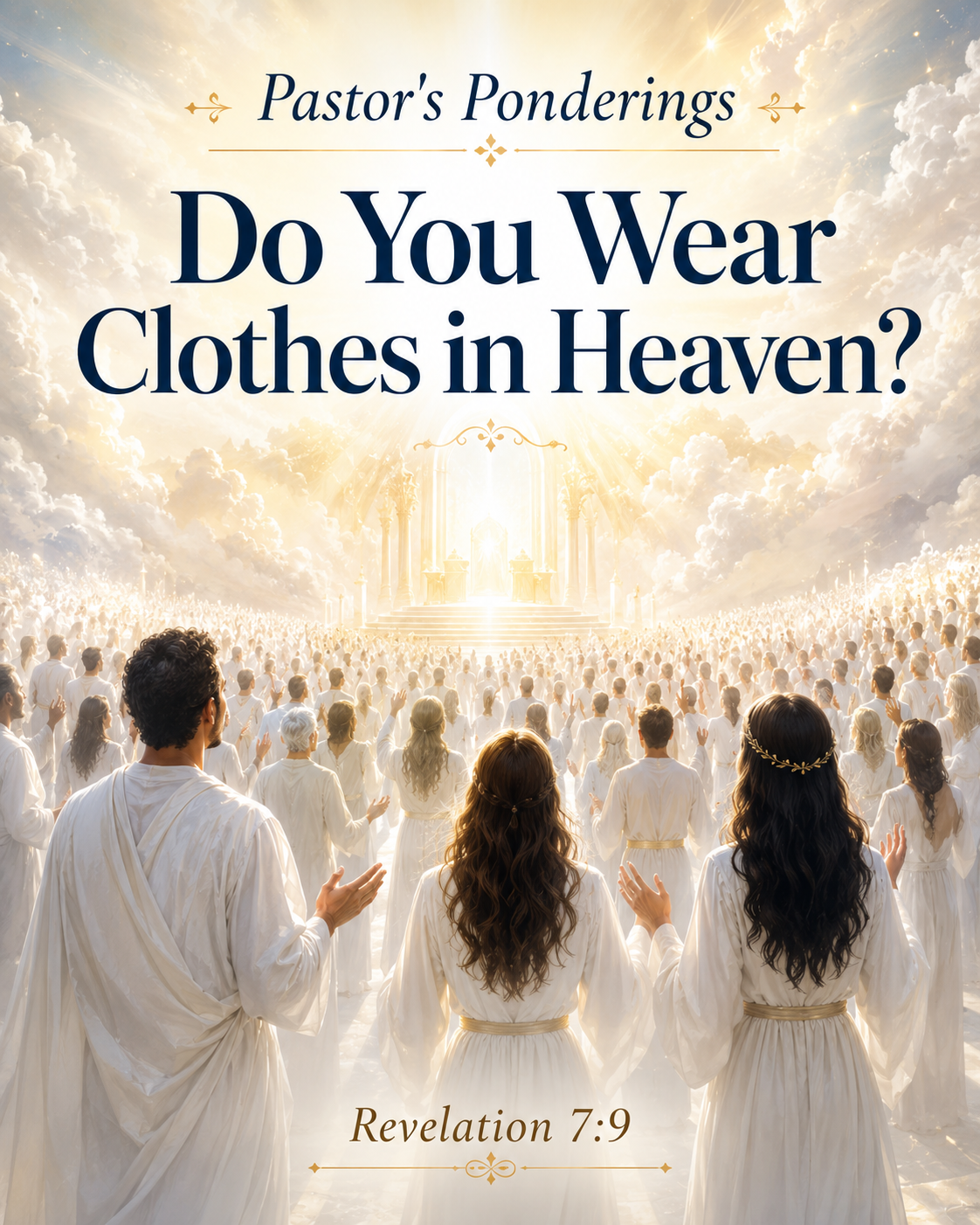
Many of the questions that you all sent in for Stump the Pastor were a bit on the heavy side, so I thought maybe we would have a lighter one to break up some of the more difficult ones.
Do you wear clothes in heaven?
What makes this question so fascinating is that we often view the afterlife as a restoration of Creation. So, we imagine what life would have been like for Adam and Eve in Eden and equate that with the paradise to come. I think that in many ways that is a faithful way to go, but unfortunately, we do not understand life before the Fall as much as we would maybe like.
We do know this: before sin entered the world, Adam and Eve “were both naked and were not ashamed” (Genesis 2:25). There was no shame. No fear. No lust. No selfishness. No sense that the other person might use or harm them. They lived in perfect innocence before God and before one another.
But after sin entered the world, shame entered with it. “Then the eyes of both were opened, and they knew that they were naked” (Genesis 3:7). It was not merely that they suddenly noticed they had no clothes. It was that sin had shattered their innocence. They became vulnerable in a way they had never been before. They hid from God. They covered themselves from one another. It is truly sad what sin—humanity gaining the capacity to understand and do evil to one another—did to our relationship with God and one another.
But I digress.
If we only looked at Eden before the Fall, we might guess that clothes would be unnecessary in the New Creation. After all, if shame is gone, why would we need covering? But that explanation is rather insufficient, and it is not the main picture that we see in the Revelation to St. John.
John describes the saints in heaven this way:
“After this I looked, and behold, a great multitude that no one could number… standing before the throne and before the Lamb, clothed in white robes” (Revelation 7:9).
That is the clearest picture Scripture gives us. The saints are standing before the throne of God and the Lamb, and they are clothed in white robes.
Now, there is a chance that this is metaphorical. The white robe is used several times in Scripture as a picture of the purity and perfection that we will enjoy in the life to come. David prays in Psalm 51:7, “Wash me, and I shall be whiter than snow.” Isaiah 1:18 says, “Though your sins are like scarlet, they shall be as white as snow.” Revelation 19:8 describes the Bride of Christ, the Church, saying, “It was granted her to clothe herself with fine linen, bright and pure.”
So the robe is certainly symbolic. It points to holiness, purity, forgiveness, and righteousness. But that does not mean it is only symbolic.
In fact, clothing is a powerful theme all throughout Scripture. After Adam and Eve sinned, they tried to cover themselves with fig leaves. But their own covering was not enough. So God Himself clothed them: “And the Lord God made for Adam and for his wife garments of skins and clothed them” (Genesis 3:21).
That is a beautiful picture. From the very beginning, sinners could not properly cover their own shame. God had to cover them. God had to clothe them.
That theme continues in Christ. St. Paul writes, “For as many of you as were baptized into Christ have put on Christ” (Galatians 3:27). In Baptism, we are clothed with Christ Himself. His righteousness covers our sin. His holiness covers our shame. His death and resurrection become ours.
This is why the white robe is important to us. This is why baptismal candidates often wear white when they are baptized. This is why confirmands wear white at their confirmation. This is why I wear white on traditional Sundays as I act as the distributor of God’s good gifts. It even has some connection to the wedding dress.
Scripture describes marriage as an illustration of our relationship with God. In that same illustration, Paul describes Christ loving the Church as His bride, cleansing her “so that He might present the church to Himself in splendor, without spot or wrinkle or any such thing” (Ephesians 5:27). The Church is made spotless and pure by the love and sacrifice of her Bridegroom, Jesus.
All of these things point to our desire for the purification of our whole selves by the blood of Jesus. This purification is the gracious gift Christ won for us on the cross, making us fit to stand before God.
Even Augustine, one of the great theologians of the early Church, spent more time focusing on the glory and perfection of the resurrected body than on the practical question of fabric. His point was not so much whether we will need clothes as we know them now, but that in the resurrection our bodies will be whole, glorified, healed, and free from shame. That is probably the safer emphasis. Heaven will not be marked by embarrassment, temptation, lust, or fear. It will be marked by holiness, joy, and peace in the presence of God.
So, do we wear clothes in heaven?
The honest answer is: I do not know for certain. The Bible does not answer the question in the same practical way that we might ask it. I would lean toward yes, we will wear clothes in heaven because of John’s Revelation and because clothing is described in connection with our salvation in more than a few meaningful places in Scripture.
But the more important answer is this: whether literal or symbolic, the saints are covered. They are clothed in white. They are washed clean. They are made pure. They stand before the throne not in shame, but in joy.
And that covering does not come from us.
It comes from Christ.
So maybe this will be one of those fun discoveries when we get to heaven. But until then, we can rejoice in what Scripture does make clear: in Christ, our shame is covered, our sins are washed away, and we have been clothed with the righteousness of Jesus.