Stump the Pastor 10: What's the Difference Between False Prophets and the Antichrist?
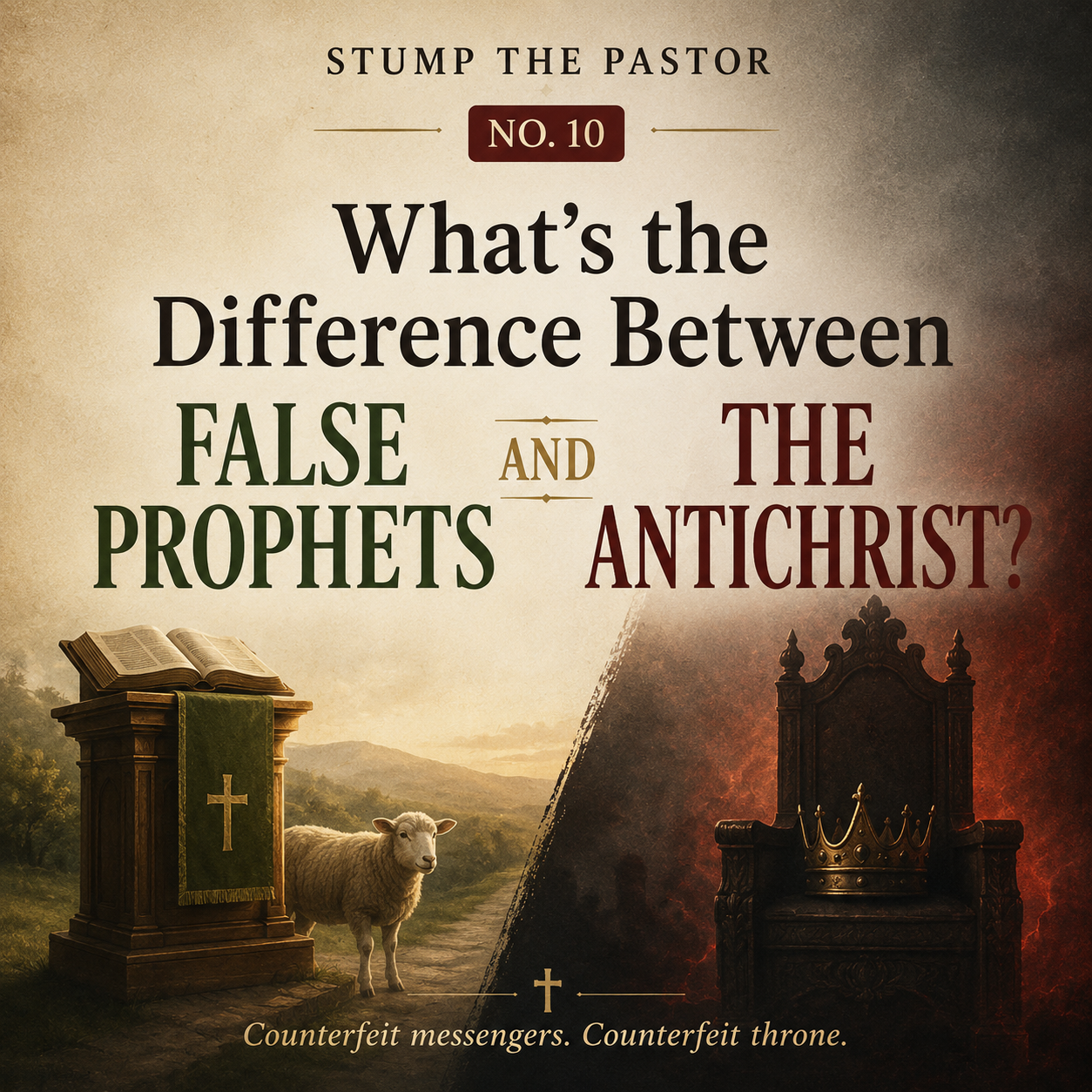
A question that sounds simple but opens up into something much bigger: what's the difference between a false prophet and the antichrist? Scripture uses both terms, sometimes in the same breath, and it's easy to blur them together into one vague category of "bad religious stuff out there." But the Bible actually distinguishes them — and understanding that distinction takes us somewhere far more personal than end-times speculation. It takes us straight to the question of who, or what, sits on the throne of your heart.
Let's work through this carefully.
A reader recently asked a question that sounds simple but opens up into something much bigger: what's the difference between a false prophet and the antichrist? Scripture uses both terms, sometimes in the same breath, and it's easy to blur them together into one vague category of "bad religious stuff out there." But the Bible actually distinguishes them — and understanding that distinction takes us somewhere far more personal than end-times speculation. It takes us straight to the question of who, or what, sits on the throne of your heart.
Let's work through this carefully.
False Prophets: Counterfeit Messengers
A false prophet is someone who claims to speak for God but doesn't. That's the simplest definition, and Scripture gives it to us early and often. God warned His people about this back in Deuteronomy, long before the New Testament ever used the word "antichrist." A prophet who spoke presumptuously, or who led people after other gods even while performing signs, was to be rejected — no matter how convincing the performance (Deuteronomy 13:1-5; 18:20-22).
Jesus renews this warning for His own disciples: false prophets will come "in sheep's clothing," looking like the real thing, and you'll know them "by their fruits" (Matthew 7:15-20). He repeats it again when describing the last days — false christs and false prophets who will "perform great signs and wonders, so as to lead astray, if possible, even the elect" (Matthew 24:24). Peter and John both pick up the theme: false prophets and false teachers will secretly bring in destructive heresies, often for profit (2 Peter 2:1-3), and John tells the church plainly, "test the spirits to see whether they are from God, for many false prophets have gone out into the world" (1 John 4:1).
Notice the pattern. A false prophet:
Claims religious authority. They speak in God's name, use the church's vocabulary, and often occupy positions of trust.
Mixes truth with error. Rarely do false prophets deny everything true. They usually affirm enough to sound credible while smuggling in something false — a different god, a different law, a different way of salvation.
Is tested by fruit and doctrine. Jesus tells us to look at outcomes and consequences. John tells us to test the content: does this teaching confess that Jesus Christ has come in the flesh, that He is Lord, that He alone saves?
Often serves self-interest. Peter is blunt that greed is frequently at the root.
A false prophet, in short, is a counterfeit messenger. They stand in the pulpit, so to speak, and lie about what God has said.
The Antichrist: A Counterfeit Christ
The antichrist is something different, and the difference is right there in the name. The Greek prefix anti- carries two meanings in the New Testament, and both are in play. It can mean "against," but it can also mean "instead of" or "in place of." The antichrist isn't simply someone who opposes Christ from the outside — he's someone (or something) who tries to occupy Christ's own seat. He doesn't just fight the throne. He tries to sit in it.
John is the only New Testament writer who actually uses the word "antichrist," and what he says is striking. He tells his readers that they've heard "antichrist is coming," but then adds that "now many antichrists have come" already (1 John 2:18). He defines the antichrist not primarily by violence or political power, but by denial — anyone who denies that Jesus is the Christ, anyone who denies the Father and the Son (1 John 2:22), anyone who refuses to confess Jesus Christ come in the flesh (1 John 4:2-3; 2 John 7). And then comes the line that should stop us: "this is the spirit of the antichrist, which you heard was coming and now is in the world already" (1 John 4:3).
Paul, writing earlier, gives us the fuller eschatological picture in 2 Thessalonians 2. He describes a "man of lawlessness," a figure who "opposes and exalts himself against every so-called god or object of worship, so that he takes his seat in the temple of God, proclaiming himself to be God" (2 Thessalonians 2:3-4). Paul says this figure's coming will be "by the activity of Satan," accompanied by false signs and wonders, and deception for those who refuse to love the truth (2 Thessalonians 2:9-10).
So the biblical picture of the antichrist has two layers held together, not two competing options:
A future, personal figure — Paul's "man of lawlessness," a climactic embodiment of this opposition to Christ that will appear before the end.
A present, ongoing spirit — already active in John's own day, and every day since, wherever someone or something usurps the place that belongs to Christ alone.
That second layer is the one I want us to sit with, because it's the one that touches your life and mine every week.
Luther and the Papacy — A Word of Context
You may know that the Lutheran confessions apply the term "antichrist" to the papacy (see Smalcald Articles, Part II, Article IV). This wasn't a throwaway insult. Luther's argument was specific: the papal office, as it was defined and defended in his day, claimed an authority that belongs to Christ alone — the power to bind consciences, to add necessary conditions to salvation beyond Christ's finished work, and to stand as a required mediator between the believer and God. Luther's concern was doctrinal, not personal; it was about an office claiming Christ's own prerogatives, which is precisely what John and Paul describe.
A pastoral note: this is a historically situated confessional argument, tied to a specific 16th-century controversy over indulgences, purgatory, and papal authority. Ecumenical relationships and Catholic teaching have both developed since then in ways worth acknowledging.
The Antichrist Closer to Home
Here's where this stops being a history lesson and becomes an examination of the heart. If "antichrist" means anything that takes Christ's seat, then the most dangerous antichrist you'll ever meet probably isn't a future world leader. It's whatever, right now, is quietly asking you to trust it the way you should trust Christ alone.
Luther makes this exact point in his explanation of the First Commandment in the Large Catechism: "whatever your heart clings to and confides in, that is really your God." An idol doesn't need a temple. It just needs your trust. And once something has your trust — your sense of security, your hope for forgiveness, your source of identity and worth — it has taken the seat that belongs to Christ, whether or not it ever calls itself religious.
This can look like:
Self-righteousness — trusting your own performance, your own goodness, your own theological correctness, to secure what only Christ's righteousness can secure.
A false gospel of self-improvement — the promise that if you just optimize enough, heal enough, achieve enough, you'll finally be whole, safe, or worthy.
Another person's approval — letting someone else's opinion of you carry the weight that only God's verdict over you in Christ can bear.
Politics, nation, or ideology treated as savior — expecting from Caesar what only Christ can give.
A counterfeit doctrine within the church itself — teaching that sounds Christian, uses Christian words, but quietly relocates your confidence away from Christ's cross and empty tomb.
None of these need to deny Jesus outright to function as antichrist in your life. They just need to take His seat. That's the sober truth this passage forces on us: the spirit of antichrist isn't only "out there." Left unchecked, it's perfectly at home in a believer's own heart, offering counterfeit peace in place of the real thing.
The Gospel Answer
Here's the good news, and I don't want it to feel tacked on at the end — it's actually the whole reason any of this matters. Christ's seat cannot actually be stolen. Every false prophet, every antichrist, every idol you or I have ever trusted instead of Him is, in the end, a pretender occupying a throne that was never really theirs to take. Jesus said all authority in heaven and on earth has been given to Him (Matthew 28:18), and that authority was won and sealed on a cross and by an empty tomb, not by our vigilance in spotting fakes.
That means your standing before God was never actually up for grabs. Whatever has quietly taken Christ's seat in your heart this week — performance, approval, anxiety, whatever it is — Christ has already atoned for that idolatry too. He doesn't just warn you about counterfeits from a distance; He died to forgive you for trusting them, and He rose to keep calling you back. The test John gives us — "does this confess Jesus Christ come in the flesh?" — isn't only a filter for sorting out bad teachers. It's an invitation, repeated as often as you need it, back to the one throne that actually holds.
Practically, this means the antidote to antichrist, small and large, is the same: return again and again to Christ crucified and risen, delivered to you concretely in His Word, in your Baptism, in the Supper, in the absolution spoken over you. These are the places where He reasserts, gently and patiently, that the seat is His — and that He has claimed you as His own.