Stump the Pastor 8: How Can the Trinity Be True?
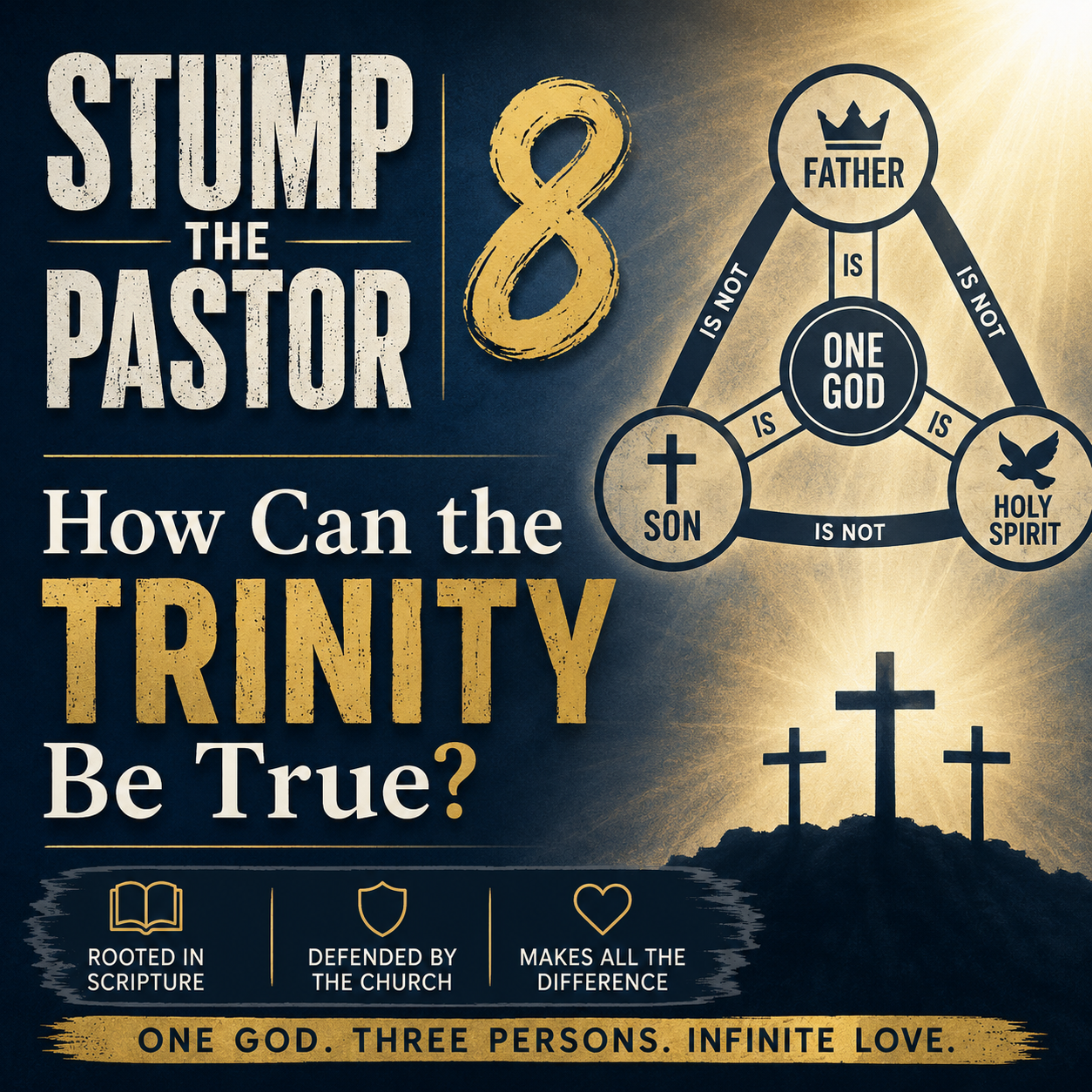
This question was asked a few weeks ago, and it came up in Bible Study this last Sunday. So I thought we should talk about this. The short answer every honest pastor eventually gives: I don't fully know. Not in the sense that I doubt it. I confess it every Sunday in the Creed without hesitation. But in the sense that the Trinity is not a puzzle I solved and can now explain to your satisfaction. It is a mystery the Church received, defended, and still bows before.
So let's unpack it together: where this doctrine came from, what Scripture actually says, why the early Church fought so hard against Arianism, and—most importantly—what difference any of this makes for your Friday morning.
What the Church Has Always Confessed
The word "Trinity" never appears in Scripture. Neither does "Bible," for that matter, and we don't worry about that one. The Church didn't invent the doctrine of the Trinity so much as she was forced to articulate it, to find language precise enough to protect what Scripture was already teaching, against people who were teaching something else.
That work came to a head at the Council of Nicaea in AD 325. The Emperor Constantine had unified the empire, and now a priest from Alexandria named Arius was unifying it in a different direction: teaching that the Son was a created being, the first and greatest of God's creatures, but not eternal and not truly God in the same sense the Father is God. Arius had a memorable slogan: "There was a time when he was not." Catchy. Also false.
The bishops at Nicaea led in substance, if not always in title, by a young deacon named Athanasius, responded with a word that doesn't appear in Scripture either: homoousios, "of the same substance." The Son is not like the Father in essence (homoiousios, a single letter's difference that split empires). The Son is the same essence as the Father. Not a demigod. Not an exalted creature. True God of true God.
The Nicene Creed settled the question of the Son's deity. Fifty-six years later, at Constantinople in 381, the Church (helped by the Cappadocian Fathers—Basil, Gregory of Nazianzus, Gregory of Nyssa) finished the job regarding the Holy Spirit, who is likewise worshiped and glorified together with the Father and the Son, not a force or an afterthought but a Person of the one Godhead.
By the time of the Athanasian Creed, prayed for centuries on Trinity Sunday, and still printed in our hymnal, the Church had settled on language that holds two truths in tension without collapsing either one: one God, three Persons; the Persons distinct, the essence undivided. "Not confounding the Persons, nor dividing the substance," as the Creed says. That's not a riddle for its own sake. It's a fence built around a truth too easily distorted in either direction.
What Scripture Actually Says
Here's the thing people sometimes don't realize: the doctrine of the Trinity isn't built on two or three proof texts. It's built on the whole shape of the biblical witness.
It starts as early as Genesis 1:26, where God says "Let us make man in our image". Plural language that the Church Fathers heard as an early echo of something more, even if the full picture wasn't yet unveiled. It's there in the way the Angel of the LORD speaks both as God and to God throughout the Old Testament. It's there in Isaiah 6, where the seraphim cry "Holy, holy, holy", a threefold acclamation the Church has always heard as more than poetic repetition.
But the New Testament is where it comes into focus. At Jesus' baptism, all three Persons appear in a single scene: the Son standing in the water, the Spirit descending as a dove, the Father's voice from heaven (Matthew 3:16–17). Jesus commands baptism "in the name", singular, "of the Father and of the Son and of the Holy Spirit" (Matthew 28:19): one name, three Persons named within it. Paul closes 2 Corinthians with a blessing that names all three as the source of grace, love, and fellowship (2 Corinthians 13:14), the kind of thing you don't say carelessly about three unequal beings.
And then there's John 1:1: "In the beginning was the Word, and the Word was with God, and the Word was God." Both with God and was God. Distinction and unity in a single sentence. John builds his entire Gospel around this, and Jesus himself makes the claim unmistakable in John 8:58, when he doesn't say "before Abraham was, I was" but "before Abraham was, I AM". Reaching back to claim the divine name God gave Moses at the burning bush.
Answering Arius
Arius's whole argument hung on a handful of texts that, read in isolation, sound subordinationist. Jesus saying "the Father is greater than I" (John 14:28), or being called "the firstborn of all creation" (Colossians 1:15). But the Church's answer was patient and textual, not just political.
"The Father is greater than I" describes the Son in his incarnate, humbled state. The very next chapter of the story, not a statement about his eternal essence. Philippians 2 makes that explicit: the Son, existing in the form of God, emptied himself, taking the form of a servant. You can't empty yourself of something you never had.
And "firstborn of all creation" was never a claim about being the first created thing. The very next verses demolish that reading. Paul writes that by him all things were created, in heaven and on earth, visible and invisible, and that he is before all things, and in him all things hold together (Colossians 1:16–17). "Firstborn" there is a title of rank and inheritance, the way Israel is called God's firstborn among the nations, not a place in a created timeline. Hebrews 1 goes even further, calling the Son "the radiance of the glory of God and the exact imprint of his nature" (Hebrews 1:3). Language no faithful Jewish writer would ever use of a creature.
Arius wasn't defeated because Athanasius out-argued him politically, though there was plenty of that too, including Athanasius's own repeated exiles for refusing to back down. He was defeated because his system couldn't hold the whole of Scripture together. You could find Arius a few verses. You couldn't find him the Bible.
The Broader Problem of Subordinationism
Arius is the most famous name attached to this error, but he wasn't the only one, and the underlying instinct didn't die with him. Subordinationism, broadly speaking, is any teaching that ranks the Persons of the Trinity by essence. Any teaching that makes the Son or the Spirit less God than the Father, whether a little less or a lot less. It shows up in different costumes across history: in the semi-Arians who tried to split the difference with homoiousios ("similar substance") instead of homoousios ("same substance"); in Eunomius and the so-called "Anomoean" party, who pushed Arius's logic even further and said the Son was unlike the Father in essence, not merely subordinate to him; and in various forms it still takes today, including modern debates within evangelicalism over whether the Son is eternally and inherently subordinate to the Father in authority, apart from his incarnate mission. The names change. The error underneath stays remarkably consistent: take texts that describe the Son's work and read them as statements about the Son's being.
Scripture closes this door more thoroughly than even the Arianism debate alone shows. When Jesus called God his own Father, John tells us the religious leaders sought all the more to kill him, "because he was even calling God his own Father, making himself equal with God" (John 5:18) and notably, Jesus never corrects that interpretation. He doubles down on it through the rest of the chapter. In John 10:30, Jesus states plainly, "I and the Father are one," and the crowd picks up stones, understanding exactly what he meant: a man claiming to be God (John 10:33). When Thomas finally sees the risen Christ, he doesn't say "my teacher" or "my superior." He says, "My Lord and my God" (John 20:28), and Jesus accepts the confession rather than correcting it. Throughout the Gospels, Jesus does what only God does—forgives sins outright (Mark 2:5–7), calms the sea with a word (Mark 4:39, echoing Psalm 107:29), and receives worship without rebuke (Matthew 14:33; 28:9).
This is why the Nicene Creed doesn't just say the Son is "divine" in some general sense, it says "true God of true God, begotten, not made, being of one substance with the Father." That last phrase is doing precise work: begotten describes an eternal relationship of origin, not a difference in rank or a starting point in time. A son who is begotten of a human father shares his father's full humanity; he isn't a lesser kind of human. The Creed borrows that logic to say the Son shares the Father's full deity.
The key distinction the Church has always made (and that we still need today) is between the Son's eternal essence and his voluntary mission. When Jesus says "the Father is greater than I," or submits to the Father's will in Gethsemane, or is sent by the Father into the world, none of that describes an eternal hierarchy within the Godhead. It describes the Son's free, willing condescension to take on our flesh and accomplish our redemption from within it. The Athanasian Creed states the rule plainly: the Son is "equal to the Father as touching his Godhead, and inferior to the Father as touching his manhood." Equal in essence, distinct in mission. Collapse that distinction in either direction, claiming the Son was inferior even before the incarnation, or denying any voluntary submission in his earthly work, and you end up distorting either who God eternally is or what Christ actually did for you on the cross.
What This Means for You
Here's where this stops being church history and starts being your life.
If the Trinity is true, it means God is not lonely in eternity, waiting for creation to give him someone to love. Before there was a universe, before there was a single creature to receive his affection, the Father was loving the Son in the Spirit. Love is not something God decided to try out when he made you. Love is who he has eternally been. You were made into that love, not to provide it.
It also means your salvation is not a committee decision among unequal partners. The Father planned it, the Son accomplished it in his own flesh and blood, the Spirit applies it to you through water and word, and all three are fully God, fully invested, fully yours. There's no junior partner in your redemption who didn't have the authority to guarantee it. The same God who spoke creation into existence is the one who speaks "you are forgiven" over you.
And it means that when you were baptized, you weren't baptized into an idea. You were named, claimed, by the Father, the Son, and the Holy Spirit, the same three Persons who have loved each other from before time began, and who now, somehow, in grace beyond explanation, have made room in that love for you.
I can't resolve the mystery for you. Neither could Athanasius. But I can tell you the Church has stood on this ground for nearly two thousand years, against every wind of doctrine that tried to simplify God into something smaller and more manageable, because the truth was worth more than the simplicity.