Stump the Pastor 11: Can You Explain the Different Beliefs About the End Times?
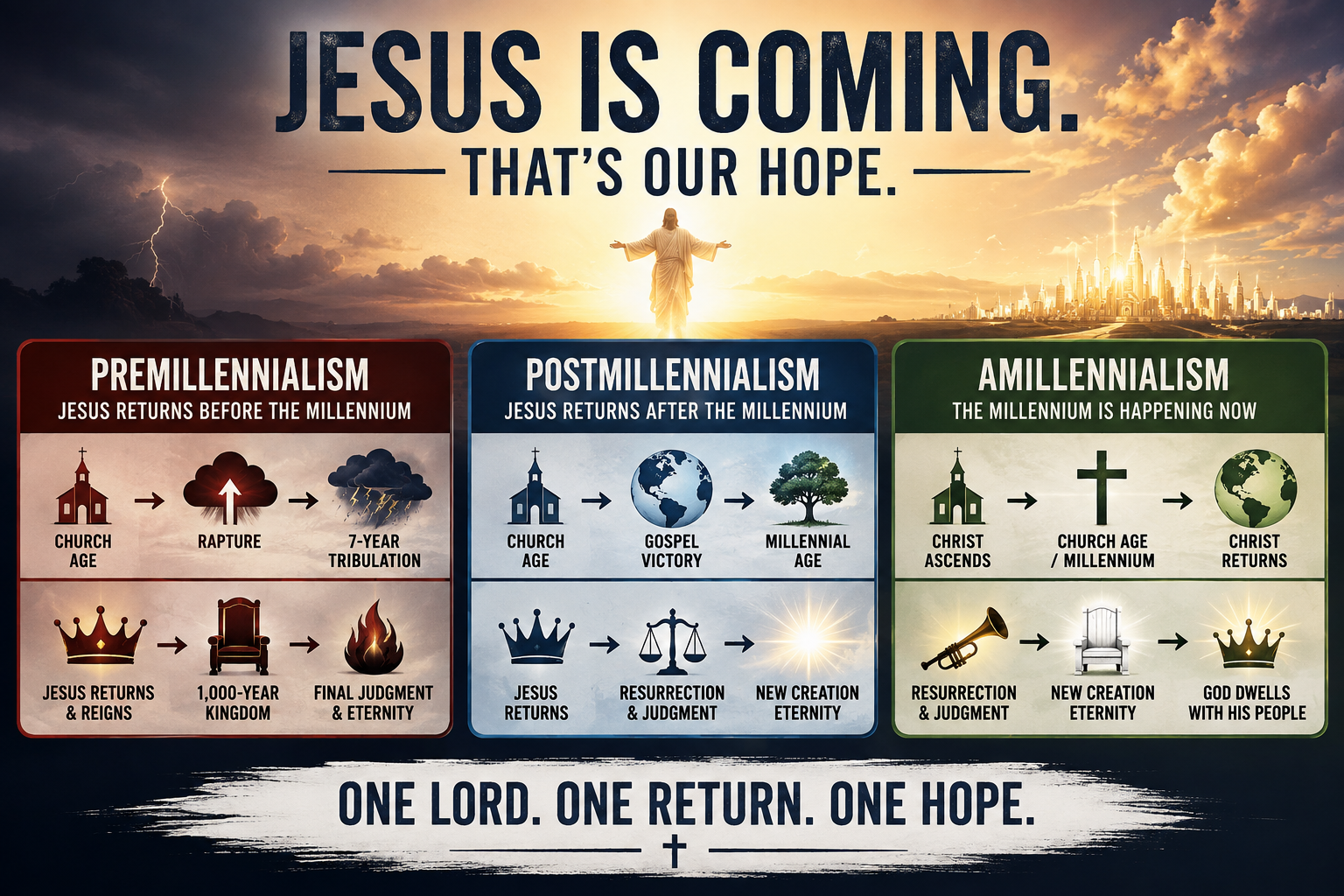
This could be the longest article I have ever written if we are not careful. Christians have spilled an incredible amount of ink discussing the end times, and I certainly don't claim to know every detail of every interpretation. There are disagreements about the millennium, the tribulation, the rapture, Israel, the Antichrist, the book of Revelation, and how all of these pieces fit together.
So rather than trying to explain every end-times theory ever proposed, I want to do two things: give a small summary of the major perspectives Christians hold and then spend a little more time explaining what we believe as Lutherans.
Thankfully, most of the major disagreements can be traced back to one particular passage: Revelation 20 and its description of a “thousand years.” When is this thousand-year reign? Is it literal or symbolic? Does Jesus return before it or after it? Is it happening now?
Those questions give us three major positions: premillennialism, postmillennialism, and amillennialism.
Premillennialism: Jesus Returns Before the Millennium
Premillennialism teaches that Jesus will return before the millennium described in Revelation 20. In other words, Christ returns and then establishes a special earthly reign.
There are actually a couple of important versions of this belief.
Historic premillennialism teaches that the Church will continue through tribulation and persecution until Christ visibly returns. Jesus raises His people, defeats His enemies, and establishes His millennial kingdom. After this comes the final defeat of Satan, the final judgment, and eternity.
This is an ancient belief. Versions of it can be found among some Christians in the early Church. It is important to mention this because premillennialism does not automatically mean someone believes in a secret rapture or everything you might have seen in a Left Behind movie.
The version much more familiar to modern American Christians is dispensational premillennialism.
This is the system behind the popular Left Behind understanding of the end times. Although there are variations, the familiar timeline looks something like this:
Church Age → Rapture → Seven-Year Tribulation → Visible Return of Jesus → 1,000-Year Earthly Reign → Final Rebellion → Judgment → Eternity
In this view, Jesus first returns secretly to “rapture” believers away from the earth. Those remaining endure a seven-year tribulation. Jesus then returns visibly, defeats His enemies, and reigns physically upon the earth for one thousand years.
Dispensationalism also commonly makes a strong distinction between Israel and the Church. God is understood to have particular promises for ethnic and national Israel that still need to be fulfilled during the end times.
This is probably the end-times system you are most likely to encounter on Christian television, prophecy websites, popular books, and movies.
Postmillennialism: Jesus Returns After the Millennium
Postmillennialism takes a much more optimistic view of history.
It teaches that through the preaching of the Gospel, the Kingdom of God will increasingly influence the world. Christianity will flourish, righteousness will spread, and the world will experience an extended period of extraordinary Gospel prosperity—the “millennium.”
Then Christ returns.
So the simplified timeline looks something like:
Church Age → Increasing Gospel Victory and Millennial Age → Christ Returns → Resurrection and Judgment → New Creation
Not every postmillennialist believes the millennium must be exactly one thousand calendar years. The emphasis is that Christ returns after this extraordinary period of Gospel flourishing.
There are many nuances within this position, but that is probably enough for our purposes here.
Amillennialism: The Millennium Is Happening Now
This brings us to the position historically associated with Lutheran Christianity: amillennialism.
Unfortunately, the name can be misleading. A-millennial sounds as though we are saying, “There is no millennium.”
That isn't what we believe.
We believe Revelation 20's “thousand years” symbolically describes the present reign of Christ during the age in which we are living right now. The LCMS has sometimes called this the “Church Age.”
Jesus is already King.
He is already reigning.
Satan has already been defeated through Christ's death and resurrection.
The Gospel is already going out into the nations.
But Christ's victory has not yet been revealed in all its fullness. Sin, death, persecution, suffering, and unbelief remain. Satan is defeated, but he is still dangerous. The Church therefore lives in a wonderful tension that theologians sometimes describe as the “already and not yet.”
Christ has already won.
His Kingdom has already come among us.
Death has already been defeated.
And yet we have not yet seen the final resurrection.
We have not yet seen evil completely removed.
We have not yet entered the new heavens and new earth.
That will happen when Jesus returns.
So the Lutheran timeline is considerably simpler:
Christ Ascends → Church Age / Millennium → Christ Returns → Resurrection → Judgment → New Creation
That's really it.
But let's unpack what we mean by that.
Jesus Really Is Coming Back
This is the most important part of Christian teaching about the end times.
Not the Antichrist.
Not the mark of the beast.
Not figuring out what country represents which beast in Revelation.
Not trying to determine whether this week's earthquake, war, election, technology, or international crisis finally unlocked biblical prophecy.
Jesus Christ is coming back.
When Jesus ascended into heaven, the angels told His disciples:
“This Jesus, who was taken up from you into heaven, will come in the same way as you saw him go into heaven.”
Acts 1:11
That is our hope.
The Jesus who was conceived by the Holy Spirit, born of the Virgin Mary, crucified under Pontius Pilate, died, rose again, and ascended into heaven will return.
As we confess every Sunday in the Creed:
“He will come again with glory to judge both the living and the dead.”
Christian eschatology is ultimately not about deciphering a timeline.
It is about waiting for Jesus.
What About the Rapture?
This is usually the next question.
Do Lutherans believe in the rapture?
Yes—depending on what you mean.
Paul writes:
“Then we who are alive, who are left, will be caught up together with them in the clouds to meet the Lord in the air.”
1 Thessalonians 4:17
We absolutely believe that.
When Jesus returns, Christians who are still alive will be “caught up” to meet Him. In fact, our English word rapture comes from the Latin word used to translate Paul's language of being “caught up.”
What Lutherans reject is the idea of a secret rapture separated from Christ's final return.
Look at how Paul describes the event:
“The Lord himself will descend from heaven with a cry of command, with the voice of an archangel, and with the sound of the trumpet of God.”
1 Thessalonians 4:16
That doesn't sound particularly secret.
Revelation 1:7 says:
“Behold, he is coming with the clouds, and every eye will see him.”
We do not believe Jesus secretly returns, removes Christians, waits seven years, returns publicly, establishes another earthly kingdom, and then eventually brings history to its conclusion.
We believe Jesus returns once—visibly, gloriously, unmistakably.
When He comes, everybody will know.
What Happens When Jesus Returns?
Again, the Lutheran answer is refreshingly straightforward.
Jesus returns.
The dead are raised.
The living are gathered before Him.
The final judgment takes place.
Evil is destroyed forever.
And God's people enter the new creation.
Jesus says:
“An hour is coming when all who are in the tombs will hear his voice and come out.”
John 5:28–29
Notice that Jesus describes the resurrection of both believers and unbelievers together. We are not looking for several different resurrections separated by hundreds or thousands of years.
This is exactly what the Augsburg Confession has taught Lutherans for nearly five hundred years:
“At the Consummation of the World Christ will appear for judgment, and will raise up all the dead.”
The Confession continues by saying that Christ will give everlasting life and joy to those who belong to Him and everlasting condemnation to those who reject Him.
There is a Last Day.
There is a resurrection.
There is a judgment.
And then there is eternity.
So What Are the “Thousand Years”?
This is where Revelation can make things feel complicated.
Revelation is filled with symbolic imagery and symbolic numbers. We encounter seven churches, seven seals, seven trumpets, twelve tribes, twelve apostles, 144,000 saints, beasts, dragons, horns, lampstands, bowls, and countless other images.
So when Revelation 20 speaks about “a thousand years,” Lutherans do not suddenly assume that this one number must be read as a literal stopwatch counting exactly 365,000 days.
Instead, the thousand years symbolize the fullness of the time God has appointed for Christ's present reign with His Church.
This is where the term amillennial can be unfortunate. We aren't denying the millennium.
We believe we are living in it.
Christ reigns now.
The Church proclaims His Gospel now.
People are being brought out of darkness into Christ's Kingdom now.
Satan cannot stop the Gospel from going into the nations.
Yet Christians still suffer. Jesus never promised His Church that history would steadily become easier until everything finally turned into paradise.
Quite the opposite.
Jesus tells us:
“In the world you will have tribulation. But take heart; I have overcome the world.”
John 16:33
Notice what He does not say.
He doesn't say, “Don't worry; I will remove you before tribulation happens.”
He says tribulation will happen.
Then He gives us something better than an escape:
“I have overcome the world.”
That is a deeply important distinction.
Christian hope isn't that God will make sure we never have to suffer.
Christian hope is that no suffering—not persecution, not tragedy, not Satan, and not even death itself—can separate us from Jesus Christ.
What About Israel?
This is another place where Lutheranism differs significantly from dispensational theology.
Some end-times systems treat Israel and the Christian Church almost like two separate peoples of God with two separate prophetic programs.
Lutherans do not.
There has only ever been one Savior.
There has only ever been one Gospel.
There has only ever been one way of salvation: faith in God's promised Messiah.
Paul writes:
“There is no distinction between Jew and Greek; for the same Lord is Lord of all.”
Romans 10:12
And again:
“If you are Christ's, then you are Abraham's offspring, heirs according to promise.”
Galatians 3:29
The Old Testament promises are not abandoned. They find their fulfillment in Jesus Christ.
This certainly does not mean that God has ceased loving the Jewish people or that Christians should be indifferent toward them. Paul himself expresses extraordinary love and concern for his fellow Israelites in Romans 9–11.
But Jewish people need the same Savior that Gentiles need: Jesus.
The modern nation of Israel therefore does not provide Christians with a separate timetable through which we can calculate the date of Christ's return.
Our eyes remain fixed on Christ.
Can We Figure Out When Jesus Is Coming?
No.
Jesus says:
“Concerning that day and hour no one knows.”
Matthew 24:36
And yet Christians have spent almost two thousand years trying anyway.
Every generation seems to discover someone who believes they finally solved it.
Wars begin.
Governments rise.
Governments fall.
Technology advances.
A new world leader emerges.
Someone invents a new form of currency.
A plague spreads.
A temple rumor circulates.
Someone does enough math with Daniel and Revelation to produce a date.
And somehow every generation becomes convinced that this time somebody has cracked the code.
But Jesus didn't tell us to crack the code.
He told us to be ready.
There is an enormous difference.
Being ready for Christ doesn't mean knowing when He is coming.
It means knowing Who is coming.
The Point Isn't the Timeline. The Point Is Jesus.
This may be the most important thing I can say about all of this.
You can become so obsessed with the end times that you completely miss the point of the end times.
If your study of Revelation leaves you terrified of technology, obsessed with world politics, staring suspiciously at barcodes, calculating dates, identifying every new villain as the Antichrist, or wondering whether you accidentally missed the rapture, something has gone wrong.
Revelation wasn't written to terrify faithful Christians.
It was written to comfort Christians who were already terrified.
They were suffering.
They were persecuted.
The Roman Empire looked unstoppable.
Christians were weak.
Their enemies were powerful.
And Revelation pulled back the curtain and showed them reality:
The Lamb wins.
Jesus reigns.
Satan's days are numbered.
Death will not have the last word.
The martyrs will rise.
The graves will open.
Christ will return.
God will dwell with His people.
And:
“He will wipe away every tear from their eyes, and death shall be no more.”
Revelation 21:4
That is what Christians are waiting for.
Our hope isn't:
I figured out Revelation.
Our hope is:
Jesus died for me.
Jesus rose for me.
Jesus reigns for me.
Jesus is coming back for me.
Jesus will raise me from the dead.
Jesus will make all things new.
There are plenty of details about the end times that faithful Christians will continue to debate. There are plenty of passages that I would approach with humility rather than pretending I have every image completely figured out.
But the most important things are beautifully clear.
Jesus Christ is risen.
Jesus Christ reigns.
Jesus Christ is coming again.
The dead will rise.
Evil will end.
Creation will be restored.
And everyone who trusts in Christ will live with Him forever.
So perhaps the best Christian response to all of our questions about the end times isn't another chart.
Maybe it is simply the prayer with which Scripture itself concludes:
“Amen. Come, Lord Jesus!”
Revelation 22:20